

In a world full of rapid change and uncertainty, finding new ways to adapt and thrive has never been more critical. Understanding how to build resilience is the key to turning setbacks into opportunities, strengthening well-being, and driving long-term success.
Table of Contents: Why Invest in Resilience
Key Takeaways
| Point | Details |
| Understanding Resilience | Resilience is a dynamic process that allows adaptation and growth, encompassing mental fortitude, emotional intelligence, and strategic problem-solving. |
| Types of Resilience | Personal, team, and organizational resilience each have unique characteristics and require tailored development strategies for effectiveness. |
| Benefits of Resilience | Cultivating resilience leads to improved performance, emotional stability, and enhanced problem-solving capabilities across personal and group contexts. |
| Common Misconceptions | Resilience is not a fixed trait or absence of stress; it must be actively developed through practice, emotional intelligence, and continuous learning. |
Defining Resilience and Its Essential Role
Resilience is more than just bouncing back after setbacks. It is a dynamic psychological process that enables individuals and organizations to adapt, transform, and grow through challenging circumstances. According to research from National Academies Press, resilience fundamentally involves leadership’s capacity to foster a culture of adaptability and well-being.
At its core, resilience represents an intricate combination of mental fortitude, emotional intelligence, and strategic problem-solving. The National Center for Biotechnology Information highlights that resilience isn’t just an inherent trait but a skill that can be systematically developed through targeted practices. Organizations and individuals who invest in resilience training demonstrate remarkable abilities to:
- Navigate unpredictable environments
- Maintain performance under pressure
- Transform challenges into opportunities
- Sustain psychological well-being
Building resilience requires a holistic approach that integrates personal development, leadership strategies, and continuous learning. While some people might seem naturally resilient, research confirms that these skills can be learned and strengthened over time. 7 Key Resilience Building Exercises for Growth provides practical techniques for anyone seeking to enhance their adaptive capabilities and emotional strength. Ultimately, resilience isn’t about avoiding difficulties but developing the mental framework to process, learn, and emerge stronger from life’s inevitable challenges.

Types of Resilience: Personal, Team, Organizational
Resilience is not a monolithic concept but a multifaceted approach to navigating challenges across different domains of human experience. According to research from Eagle Publications, resilience manifests distinctly in personal, team, and organizational contexts, each with unique characteristics and development strategies.
Personal Resilience represents an individual’s psychological capacity to adapt and bounce back from personal setbacks. This involves developing emotional regulation, self-awareness, and strong coping mechanisms. Individuals with high personal resilience can transform personal challenges into opportunities for growth and learning.
Team Resilience shifts the focus from individual to collective adaptation. In team settings, resilience emerges through collaborative problem-solving, mutual support, and shared mental models. Leading with Heart and Mind: What is the Most Overlooked Dimension of Teamwork explores how emotional intelligence and communication play critical roles in building team resilience.
Organizational resilience represents the systemic ability of an organization to anticipate, respond to, and recover from unexpected disruptions. From the American Association of School Administrators, we understand that organizational resilience involves:
- Adaptive leadership strategies
- Flexible strategic planning
- Strong communication networks
- Continuous learning cultures
- Robust risk management processes
Understanding these interconnected types of resilience allows individuals and organizations to develop comprehensive strategies for thriving in an increasingly complex and unpredictable world.
Here’s a comparison of the three primary types of resilience:
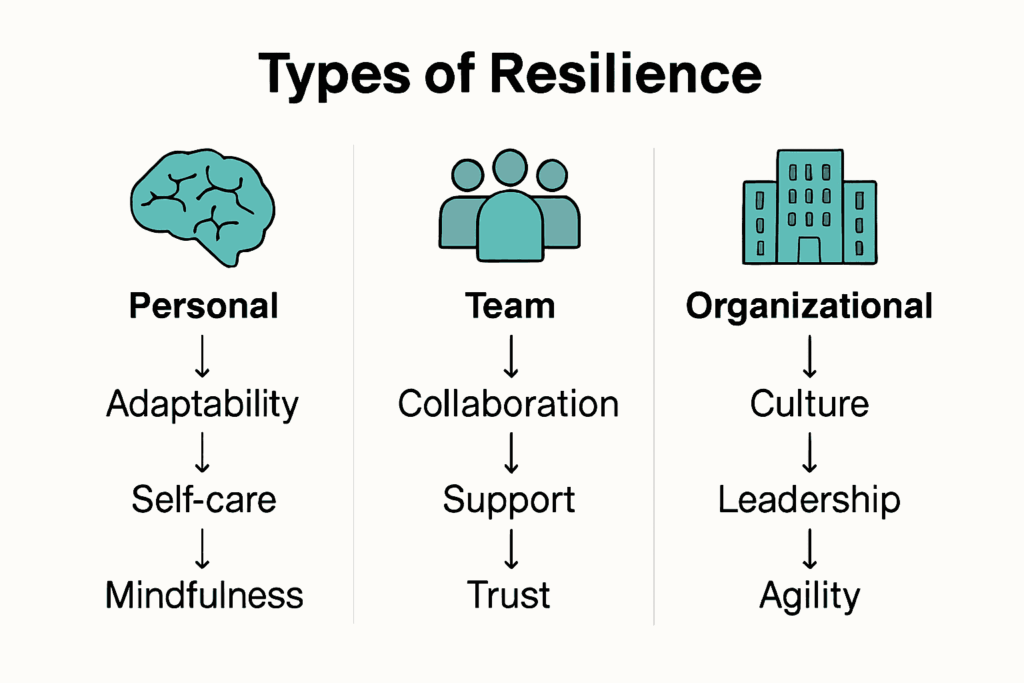
| Type | Key Characteristics | Development Strategies |
| Personal Resilience | Emotional regulation Self-awareness Coping mechanisms | Mindfulness Self-reflection Emotional intelligence training |
| Team Resilience | Collaborative problem-solving Mutual support Shared mental models | Open communication Team-building exercises Conflict resolution skills |
| Organizational Resilience | Adaptive leadership Flexible planning Continuous learning | Leadership training Risk management practices Learning culture initiatives |
Key Benefits for Individuals and Groups
Resilience is not just a theoretical concept but a powerful catalyst for transformative growth and performance across personal and professional domains. Research from Frontiers in Psychology demonstrates that individuals who cultivate resilience experience significant improvements in job performance, psychological well-being, and overall life satisfaction.
Individual Benefits of resilience extend far beyond simple stress management. People with strong resilience skills develop enhanced emotional intelligence, better problem-solving capabilities, and a more adaptive mindset. These individuals can:
- Navigate complex personal challenges more effectively
- Maintain emotional stability during high-pressure situations
- Develop stronger interpersonal relationships
- Accelerate personal and professional growth
- Reduce the negative impacts of chronic stress
At the group and organizational level, resilience becomes a powerful collective resource. According to research from PMC, multiteam systems with high resilience demonstrate remarkable adaptability in complex environments. Essential Tips to Overcome Adversity and Thrive highlights that teams with robust resilience skills can:
- Respond more quickly to unexpected challenges
- Maintain cohesion during organizational disruptions
- Foster a supportive and collaborative work environment
- Sustain high performance under challenging conditions
- Create innovative solutions through collective problem-solving
Ultimately, resilience represents a strategic investment in human potential, enabling individuals and groups to transform challenges into opportunities for growth, learning, and extraordinary achievement.

How Resilience Drives Performance and Growth
Resilience is the hidden engine of high performance, transforming challenges into opportunities for unprecedented growth and development. According to research from Eagle Publications, organizations that strategically build resilience create adaptive environments that consistently outperform their competitors.
Performance Enhancement emerges through resilience by developing critical psychological and organizational capabilities. Resilient individuals and teams demonstrate remarkable abilities to:
- Maintain focus under pressure
- Rapidly adapt to changing circumstances
- Convert setbacks into learning experiences
- Sustain motivation during challenging periods
- Develop innovative problem-solving approaches
Leadership plays a pivotal role in driving performance through resilience. 7 Essential Performance Habits for Success reveals that resilient leaders create ecosystems of continuous improvement. Research from PMC highlights how leader tolerance and organizational support directly correlate with work engagement and performance.
Ultimately, resilience is not about avoiding failure but about developing the mental agility to transform potential obstacles into stepping stones for remarkable achievement. By investing in resilience, individuals and organizations unlock their capacity for sustainable growth, turning challenges into powerful opportunities for personal and collective advancement.
Common Pitfalls and Misconceptions to Avoid
Building resilience is a nuanced journey fraught with potential misunderstandings that can derail personal and organizational growth. International Journal of Social Management and Strategies warns that resilience is not a one-size-fits-all approach, cautioning against oversimplified assumptions about developing adaptive capabilities.
Misconception 1: Resilience Means Never Feeling Stressed is perhaps the most dangerous myth. True resilience isn’t about eliminating stress but developing healthy mechanisms to process and navigate challenges. People often mistakenly believe resilient individuals are impervious to emotional responses, when in reality, resilience is about understanding and managing those responses effectively.
Common Pitfalls in Resilience Development include:
- Treating resilience as a fixed trait rather than a skill
- Expecting immediate results without consistent practice
- Ignoring emotional intelligence and self-awareness
- Attempting to build resilience in isolation
- Confusing toughness with emotional suppression
Our Complete Guide to Why Embrace Adversity highlights another critical misconception: believing resilience can be developed uniformly across individual, team, and organizational levels. Each domain requires tailored strategies and approaches. Organizations frequently make the error of assuming individual resilience automatically translates to team or organizational resilience.
The path to genuine resilience demands continuous learning, self-reflection, and a commitment to growth. Recognizing these pitfalls is the first step toward developing a more authentic, sustainable approach to building psychological and organizational strength.

Build Your Resilience and Transform Adversity into Opportunity Today
Facing challenges without a clear strategy can leave you feeling overwhelmed and stuck. This article highlights the essential role of resilience in overcoming setbacks and growing stronger through adversity. If you are ready to develop the skills to navigate difficulties with confidence and turn obstacles into stepping stones, Navigating Challenges | Navigating Through Quicksand offers practical insights and support tailored to individuals and teams striving for growth.
Take control of your personal and professional growth by connecting with me at NavigatingThroughQuicksand.com. With inspirational speaking, interactive workshops, and one on one confidence coaching designed to build resilience and foster leadership, I will help you transform stress and setbacks into lasting success. Explore effective strategies on What is the Best Way to Manage Adversity in the Workplace? | Navigating Through Quicksand and visit the home page to find upcoming events and booking details. The time to build resilience and unlock your full potential is now.
Frequently Asked Questions
What is resilience and why is it important?
Resilience is a dynamic psychological process that enables individuals and organizations to adapt, transform, and grow through challenges. It fosters a culture of adaptability and well-being, improving overall performance.
How can I develop personal resilience?
Personal resilience can be developed through practices like mindfulness, self-reflection, and emotional intelligence training. These skills help individuals effectively navigate challenges and maintain emotional stability.
What are the benefits of resilience for teams and organizations?
Resilient teams and organizations respond quickly to unexpected challenges, maintain cohesion during disruptions, and foster supportive environments. This leads to greater adaptability, innovation, and sustained high performance.
What are common misconceptions about resilience?
A common misconception is that resilience means never feeling stressed. In reality, resilience involves developing healthy mechanisms to process emotions and challenges, rather than eliminating them.