


You start strong. Monday hits, the motivation is real, and for a few days everything clicks. Then life interrupts, the streak breaks, and the habit quietly disappears. If that cycle sounds familiar, you are not alone. Most people struggle with creating winning habits not because they lack discipline but because they are using the wrong tools entirely. Willpower runs dry. Inspiration fades. What actually builds lasting habits is understanding how your brain forms them and then designing your life to work with that process, not against it.
Table of Contents
Key Takeaways
| Point | Details |
| Habits form gradually | Expect habit automaticity to develop over 2 to 5 months for lasting change. |
| Use if-then plans | Link specific cues with actions to reduce reliance on willpower. |
| Design your environment | Stable contexts and immediate rewards help automate behaviors. |
| Track progress simply | Monitor habit completion with yes/no tracking and allow grace days. |
| Focus beyond motivation | Automate habits through cues and context, not just conscious effort. |
Understanding why habits matter and how they form
Before you start building new habits, it’s crucial to understand how habits actually form and why willpower is often not enough.
Your brain is always looking for shortcuts. When you repeat a behavior in a consistent context, your brain starts to encode it as a stimulus-response pattern, meaning the cue in your environment triggers the action almost automatically, with little conscious thought required. This is the foundation of habits and automatic behaviors: the brain’s habit system and its goal-directed thinking system are constantly competing, and habits form when the automatic system wins through repetition. Habit formation uses this stimulus-response system, and repetition, reinforcement, and stable contexts are what strengthen automatic habits over time.
Here is the part most people miss. Many daily behaviours happen automatically through habits rather than conscious intent. A lot of what you do today, from how you make coffee to how you respond to stress, is already running on autopilot. This is not a weakness. It is an opportunity. If you can get a behavior into that automatic zone, it stops costing you mental energy every single day.
What this tells us about self-improvement habits is clear:
- Willpower is not a long-term strategy. It depletes throughout the day and is especially unreliable during stress or fatigue.
- Context matters more than motivation. Your environment sends cues constantly. Those cues drive automatic behavior, not your morning intentions.
- Repetition is not just practice. Each repeated action in the same context strengthens the neural pathway that makes the behavior automatic.
- Goal-directed thinking is the starting point, not the endpoint. You use conscious effort to launch a habit, then design conditions so the habit runs itself.
Understanding this shifts your entire approach. You stop trying to be more disciplined and start thinking like a system designer.

Preparing to build winning habits: planning and setting realistic expectations
With an understanding of habit formation, the next step is preparing a realistic and effective plan to build your winning habits.
The most common mistake people make is jumping straight to the behavior without building a structure around it. Effective habit formation starts with specificity. Vague intentions like “I want to exercise more” have almost no staying power. What works instead is an if-then plan: “If it is 7 a.m. and I have made my coffee, then I will put on my running shoes.” If-then implementation intentions significantly increase successful habit behaviors by linking specific cues to actions, which removes the need for willpower in the moment. You have already made the decision in advance.
Timeline expectations matter just as much. Most people quit within two weeks because they expect to feel automatic by then. The reality is more nuanced. Forming a new habit typically takes 2 to 5 months to become automatic, with a median around 66 days, and setting realistic timelines prevents early failure and burnout. Complex habits, like a full gym routine, take longer than simple ones, like drinking a glass of water after waking up. Simpler, smaller actions form habits faster and with less friction, so breaking your goal into the smallest possible starting action builds automaticity much quicker.
Here is a planning comparison that shows how habit structure affects outcomes:
| Approach | Example | Likelihood of sticking |
| Vague intention | “I’ll exercise more” | Low |
| Specific goal | “I’ll run 3x per week” | Moderate |
| If-then plan with cue | “If it’s 7 a.m., then I’ll lace up and go” | High |
| If-then plan, small habit | “If it’s 7 a.m., I’ll walk 10 minutes” | Very high |
Key preparation steps for building positive habits:
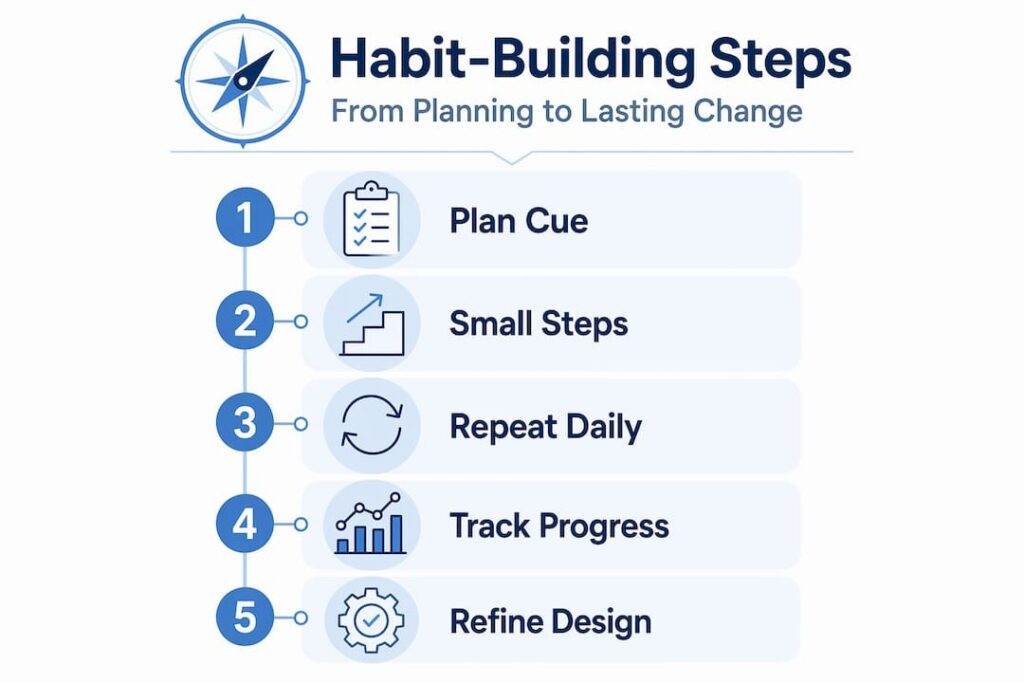
- Name your specific cue. Time of day, location, or a preceding action all work.
- Define the smallest version of the habit. Starting small is not giving up. It is smart.
- Write your if-then plan down. The act of writing anchors commitment.
- Set a 90-day minimum timeline. Commit to structured habit planning before you judge whether it is working.
Pro Tip: Link your new habit to something you already do without thinking. Your existing routines are pre-built cues. Attaching a new behavior to an established one, like completing your NTQ Performance check in right before your morning coffee, cuts the mental friction in half.

Executing your habits: repetition, reinforcement, and environmental design
After preparing your plan, executing habits daily with repetition and support is key to building lasting change.
Knowing what to do is not the hard part. Doing it consistently when motivation dips is where most people fall short. The strategies for successful habits during execution focus on three things: repetition in context, rewards that reinforce behavior, and an environment that makes the right choice easier than the wrong one.
Here is a practical execution framework you can apply immediately:
- Perform your habit at the same time every day. Morning habits tend to be more resilient than evening ones because decision fatigue has not yet set in. Same time, same place builds automaticity faster.
- Use immediate rewards. Your brain needs a signal that the behavior was worth it. That signal does not have to be elaborate. It can be a checkmark, a short stretch, or even just a moment of acknowledging you did it. Small, immediate feedback closes the habit loop.
- Design your environment to reduce friction. If your gym bag is packed the night before and sitting by the door, you are far more likely to use it. Stable contexts and consistent repetition strengthen stimulus-response habits and help disengage intentional control over time. Remove the obstacles before they become excuses.
- Stack visual cues in your space. Put the book on your pillow if you want to read before bed. Place the vitamins next to the coffee maker. Visible cues in your environment prompt automatic behavior without any thought required.
- Use a simple tracking system. Tools for habit monitoring can make daily tracking straightforward and keep the feedback loop active even on your worst days.
Creating productive routines is less about adding more and more about removing the barriers standing between you and the behavior you want. A cluttered, friction-filled environment is quietly working against every habit you are trying to build.
Pro Tip: If you miss a habit, do it immediately in a reduced form rather than skipping entirely. A five-minute version of a 30-minute habit still fires the neural pathway. It keeps the chain alive and signals to your brain that this behavior has a permanent place in your day.
Verifying progress and overcoming common challenges
Successfully building habits means verifying progress and handling challenges without losing momentum.
Here is something that trips up even the most committed people: early effort does not feel like automaticity. For the first few weeks, executing your habit will still require noticeable effort. That is completely normal. Habit strength improves over weeks to months, and what you are building during that early period is the foundation, even if it does not feel effortless yet.
Tips for consistent habits during the verification phase:
- Track with yes or no, not with quality scores. Tracking binary completion rather than quality reduces perfectionism and helps maintain habit consistency. “Did I do it?” beats “Did I do it perfectly?” every time. If you need to do something better then do it better the next time…or make the adjustment immediately and do it again to hold your standard…keep following through with the action and improving it as you build the habit. For example: you can give a high five with no eye contact and little effort and still say you gave a high five yet you know that connection builds when you give a high five with direct eye contact and effort behind the action…YOU KNOW WHEN A HIGH FIVE IS OFF…so make the adjustment and quickly do it again so it has more meaning…therefore the action creates authentic connection. It is not about perfect it is about you feeling good following through…being aware of not just what you do but how you do it is important.
- Give yourself grace days. Missing a single day does not derail habit formation. The psychological reaction to that missed day is what causes most people to quit. One slip is data. It is not failure.
- Reassess, do not restart. If a habit keeps breaking at the same point, that is a signal to examine your cue, not your character.
- Avoid adding new habits too quickly. Stacking too many new behaviors at once splits your focus and weakens each individual habit’s formation.
Here is a quick comparison of the most common habit pitfalls and how to handle them:
| Challenge | Common (losing) reaction | Winning response |
| Missed a day | “I’ve already ruined it, I’ll start over Monday” | Do a smaller version today, keep the streak |
| Lost motivation | Quit until inspiration returns | Use the if-then plan regardless of feeling |
| Habit feels hard after weeks | Conclude it is not working | Trust the timeline, automaticity takes months |
| Busy schedule disrupts timing | Skip until things calm down | Shrink the habit, protect the cue |
Use habit tracking and consistency tools to give yourself visible proof of progress. Seeing 18 out of 21 days completed is far more motivating than remembering you slipped three times.

Why winning habits require designing your environment, not just motivation
Here is the uncomfortable truth most habit content skips over: motivation is a feeling, and feelings are temporary. If your plan for how to develop good habits depends on waking up inspired, you have already built a fragile system.
True habit change comes from shaping cues and environments, not sheer willpower. Think about that for a moment. Many of your daily actions require no decision at all. Which means the most powerful lever you have is not only your mindset. It is also your surroundings.
I have seen this play out with athletes and teams. The ones who succeed long-term are not the ones who feel the most motivated. They are the ones who have a growth mindset and have built environments that make the desired behavior the path of least resistance. The basketball player who keeps a ball in the hallway shoots every morning not because they wake up fired up but because the cue is unavoidable. The professional who has a water bottle on their desk before they sit down hydrates without really thinking about it.
Engineering habits through repetition and stable contexts creates winning habits better than relying on conscious effort alone. This is not a soft idea. It is how your brain actually works. When you stop fighting your environment and start designing it, the habits you want begin to feel less like work and more like gravity.
The shift in thinking I want you to take away is this: stop asking “How do I get more motivated?” and start asking “What does my environment make easy?” Environment design for habits is the real foundation of lasting change. Motivation gets you started. Your environment keeps you going.
Unlock your full potential with professional guidance on habit and growth
Building winning habits on your own is absolutely possible. But having a guide who has been through the fire, studied the science, and worked with real people accelerates everything.
I work with individuals, athletes, educators, high school/college coaches, and corporate teams through professional habit coaching services designed specifically to translate research into real-world results. Whether you are looking for one-on-one life coaching or a high-energy group experience, my habit-building workshops give you the tools, accountability, and community to make lasting change stick. Want to see what transformation actually looks like? Read through the section Ashley’s story and the client results on my website that show what is possible when you commit to the process with the right support behind you.

Frequently asked questions
How long does it usually take to form a new habit?
Most habits take between 2 to 5 months to become automatic, with an average around 66 days depending on the habit’s complexity and how consistently it is practiced.
What is the most effective way to ensure my new habit sticks?
Creating a clear if-then plan that links a specific cue to an action dramatically improves results, because if-then planning improves behavior change by removing the need for in-the-moment decisions.
Can missing a day break my habit progress?
Missing a single day has minimal effect on overall habit progress. Single missed days do not reset habit formation. What matters most is how you respond to the slip, not the slip itself.
Why is willpower not enough to create lasting habits?
Many daily actions are automatic therefore relying solely on willpower is fragile. Designing your environment and cues to trigger behavior automatically builds far more sustainable habits over time.