
Your team lost. Your project failed. The promotion you worked three years for went to someone else. In those moments, the gap between people who move forward and people who stay stuck rarely comes down to talent or luck. It comes down to resilience. The good news is that resilience is a learnable skill built through strategies like growth mindset, emotional regulation, and strong support networks. It applies equally to individuals and teams. This guide walks you through the science, the preparation, the real-time execution, and the common mistakes so you can start bouncing forward.
Table of Contents
Key Takeaways
| Point | Details |
| Resilience is learned | Anyone can develop resilience using science-backed strategies and habits. |
| Growth mindset matters | Viewing setbacks as learning opportunities drives stronger, longer-term growth. |
| Team resilience is collective | Psychological safety and open communication help teams overcome adversity together. |
| Avoid maladaptive traps | Resilience isn’t endless toughness—beware of burnout or rigid thinking. |
| Action creates results | Preparedness and ongoing practice transform setbacks into stepping stones for progress. |
Understand the science of setbacks and resilience
When a setback hits, your brain registers it as a threat. Stress hormones flood your system. Focus narrows. Your capacity for creative problem-solving temporarily drops. This is not weakness; it is biology. The difference between high performers and everyone else is not that they avoid this reaction. They move through it faster and more intentionally.
Three core pillars support both individual and team resilience:
- Growth mindset: The belief that your abilities are not fixed. People with this mindset show stronger error-processing in the brain, which means they actually learn more from mistakes. Surrounding yourself with support systems with this mindset matters enormously and boosts resilience outcomes.
- Emotional regulation: The ability to recognize, name, and manage your emotional response without suppressing it.
- Support networks: Whether that is a mentor, a trusted teammate, or a coach, connection accelerates recovery.
For teams, the dynamic adds a layer of complexity. Team resilience requires psychological safety, which is the belief that you can speak up, admit mistakes, and ask questions without fear of punishment. Without it, teams hide failures, avoid risk, and stagnate.

| Factor | Individual impact | Team impact |
| Growth mindset | Faster learning from failure | Reduced blame culture |
| Emotional regulation | Lower anxiety, better decisions | Healthier team communication |
| Support networks | Faster recovery | Shared accountability |
| Psychological safety | Increased self-awareness | Innovation and honesty |
Prepare: Tools and mindset shifts for overcoming setbacks
You cannot fully predict when a setback will arrive, but you can absolutely prepare for one. Think of resilience like physical fitness. You do not start training the day before a race. You build the foundation well in advance so it is already there when you need it.
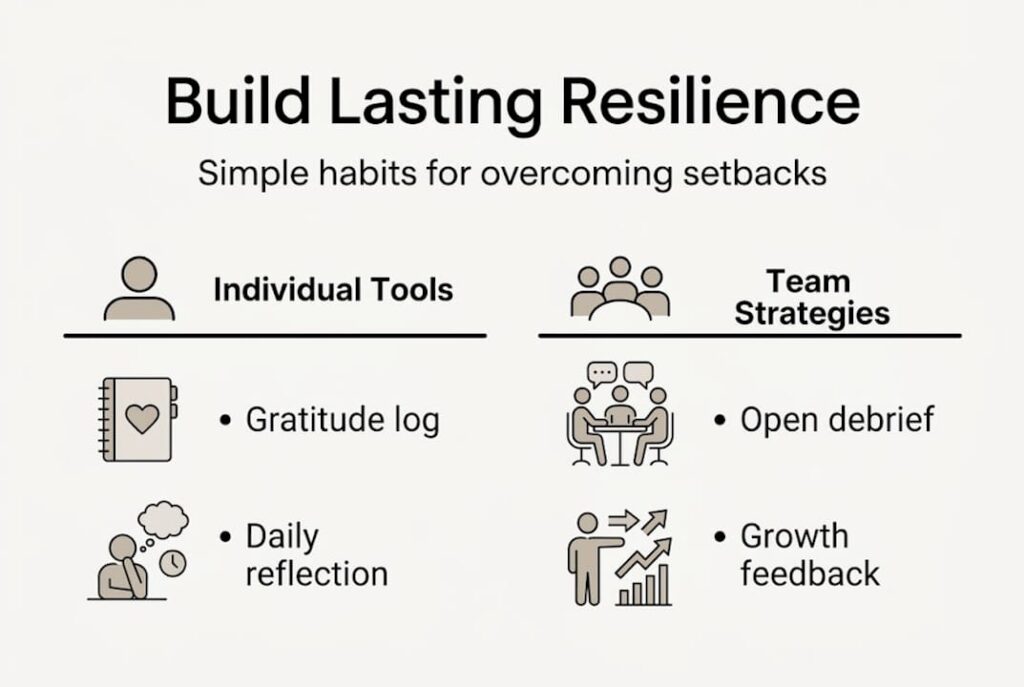
The most effective individual preparation strategies include:
- Adopt a growth mindset daily. Practice reframing failures as data. Instead of asking “Why did this happen to me?” ask “What can I learn from this?” Small language shifts create real cognitive change over time.
- Use the two good things exercise. Every evening, write down two things that went well and why. This daily practice increases positivity and strengthens the neural pathways that support resilience.
- Use the I am GRATEFUL exercise. Every morning, write down three things you are grateful for. This starts off your day with appreciation and gratitude for what you have in your life.
- Practice box breathing. Inhale for four counts, hold for four, exhale for four, hold for four. This regulates your nervous system and builds your capacity to stay calm under pressure.
- Set process goals, not just outcome goals. When you focus on what you can control (your effort, habits, and attitude), setbacks feel less catastrophic because your sense of progress is not entirely tied to results.
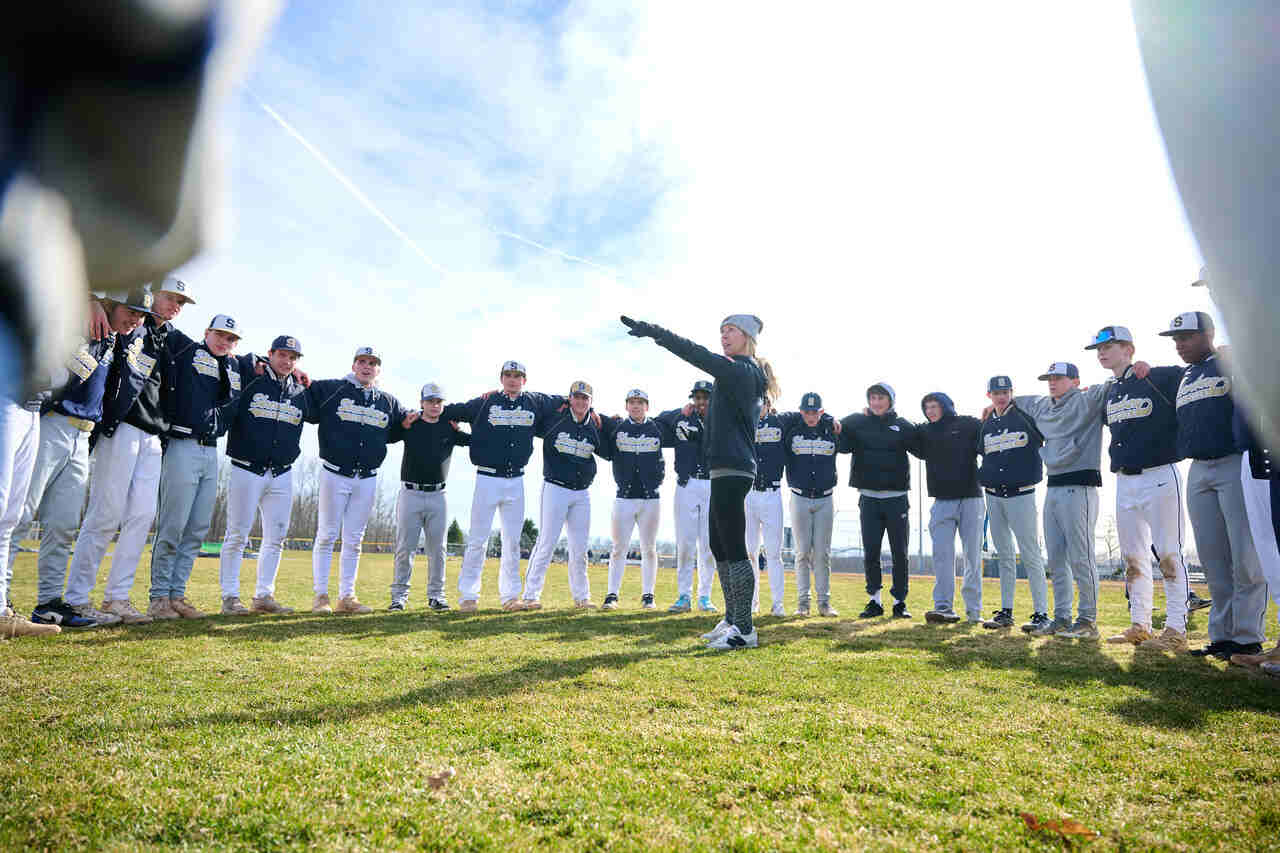
For teams, preparation looks slightly different but follows the same logic. Leaders who invest in fostering a growth mindset within their teams create environments where people are not afraid to bring problems forward early. Shared purpose also matters. When every team member can articulate why their work matters, setbacks feel like obstacles on the path rather than proof that the path was wrong.
| Individual preparation | Team preparation |
| NTQ Performance Check-ins Daily gratitude journaling | NTQ Performance Blog Conversations Regular retrospectives and open debriefs |
| Mindfulness or breathwork | Psychological safety norms and ground rules |
| Growth mindset self-talk | Shared mission and role clarity |
| Mentorship or accountability partner | Cross-training to prevent single points of failure |
Pro Tip: You do not have to overhaul your entire routine. Pick one individual habit and one team practice from the table above. Commit to both for 30 days and track what changes.
Execute: Step-by-step strategies when setbacks strike
Preparation sets the stage, but real growth happens in the heat of the moment. Here is a clear sequence to follow when adversity is fresh and raw.
- Pause before you react. In the first 60 to 90 minutes after a setback, your stress response is at its peak. Use box breathing or a short walk to give your prefrontal cortex time to come back online.
- Name what you are feeling. Research calls this “affect labeling.” Simply saying “I feel frustrated” or “I feel embarrassed” measurably reduces the intensity of the emotion. Then name an emotion you want to feel and one physical shift you can make instantly to help you attain the emotion you want to feel.
- Reframe your self-talk. Replace “I failed” with “I have not figured this out yet.” That one word, yet, signals to your brain that growth is still possible.
- Reach out to one person. Not to vent endlessly, but to get perspective. A coach, mentor, or trusted colleague can offer the outside view you cannot access when you are inside the experience.
- Define one clear next action. Momentum beats paralysis every time. A single concrete step, no matter how small, restores your sense of agency.
For teams, resilience exercises built into regular practice pay off enormously here. Resilience training that combines CBT techniques with team-building consistently enhances outcomes and improves performance across industries. Hold a structured debrief within 24 to 48 hours of a significant setback. Normalize struggle by letting a senior leader share their own story of failure first. Then clarify next actions collectively.
Pro Tip: Schedule your team debrief before the setback happens. Set a standing agenda so when it is needed, the process feels familiar rather than punitive. Pair this with individual coping with adversity practices to ensure people arrive at debriefs regulated and ready to engage.

Troubleshooting: Common pitfalls and how to avoid them
Executing new strategies does not guarantee perfection. Most people hit predictable traps, and knowing them in advance is half the battle.
The biggest mistakes individuals make:
- Fixed mindset relapse: Under pressure, even growth-minded people slip back into blame and withdrawal. Catching it early is the fix.
- Overcompensating: Working twice as hard immediately after a setback without addressing the root cause. This leads to burnout, not progress.
- Isolation: Withdrawing from support networks precisely when you need them most.
The biggest mistake teams make:
- Skipping debriefs to “move on quickly” and repeating the same failure.
Maladaptive resilience leads to burnout in teams when leaders push through problems without acknowledging them. Regulatory flexibility, the ability to adjust your emotional and behavioral response to fit the situation, is the antidote.
Statistic to know: Teams with low psychological safety in teams are significantly less likely to report errors, which means problems compound quietly until they become crises.
The fix for both individuals and teams is the same: introduce feedback loops. Ask yourself or your team weekly, “Are we adapting, or are we just enduring?” Endurance without growth is not resilience. It is survival mode.
Pro Tip: If you notice someone on your team going quiet after a setback, check in privately before the group debrief. A one-on-one conversation creates the safety needed for honest reflection.
Why bouncing forward? A modern take on resilience
Here is something most resilience conversations get wrong. The goal should never be to return to who you were before the setback. That version of you is the one the setback happened to.
The best performers I have worked with, athletes, executives, and everyday people navigating impossible circumstances, do not treat setbacks as interruptions. They treat them as information. They come out of adversity sharper, clearer, and better equipped than before.
Resilience is not a fixed trait but a set of adaptive strategies and skills that can be continuously developed. That means the goal is not recovery. It is evolution. Every setback is a chance to audit your systems, your relationships, your beliefs, and your approach. The people and teams who do this consistently are the ones who build something the rest cannot replicate: a track record of getting better under pressure.
Build your resilience journey with expert support
Knowing the strategies is a strong start. Putting them into consistent practice, especially under real pressure, is where most people and teams need a guide.
I connect with individuals, athletes, and organizations to build the kind of resilience that does not just survive adversity but uses it as fuel. Whether you are looking for hands-on resilience building exercises, a deep-dive workshop, or ongoing coaching, the resilience coaching and services available through NavigatingThroughQuicksand.com are designed to meet you where you are. Reach out today and start building the resilience that sticks.

Frequently asked questions
Is resilience something anyone can learn?
Yes. Resilience is a learnable skill built through consistent practices and adaptive strategies, not something you are born with or without.
What is a growth mindset and how does it help?
A growth mindset is the belief that your abilities improve with effort and learning. Reframing failures as opportunities to learn makes it far easier to move forward after a setback without getting stuck in shame or blame.
How can teams recover from setbacks together?
Teams rebound best when they prioritize psychological safety and structured debriefs. Team resilience mechanics include collective efficacy and adaptive leadership, which together create the conditions for honest, productive recovery.
What are signs of unhealthy or maladaptive resilience?
Burnout and denial are the clearest warning signs. Maladaptive resilience leads to burnout when teams or individuals push through problems without addressing their root causes.
Recommended
- Powerful 4-Step Guide: Navigating Challenges, Building Resilience and a Positive Mindset | Navigating Through Quicksand
- Master Mental Strength Training for Lasting Resilience | Navigating Through Quicksand
- Essential Tips to Overcome Adversity and Thrive
- 7 Key Resilience Building Exercises for Growth