

Most organizations/colleges and high schools invest heavily in leadership training, yet the gap between investment and results isn’t about whether leadership development matters, but understanding what actually works. This article reveals strategies that transform leadership training from a checkbox exercise into a genuine performance catalyst. You’ll discover what separates effective training from wasted resources, how to measure real ROI, and practical steps to choose solutions that deliver measurable team improvements.
Table of Contents
Key Takeaways
| Point | Details |
| Most programs underdeliver | The majority of leadership training fails to show measurable improvements without targeted design. |
| Effective training is practical | Impactful leadership development focuses on real-world skills and ongoing feedback, not just theory. |
| Measuring ROI is essential | Tracking before-and-after metrics helps prove the value of your leadership investment. |
| Benefits are tangible | Strong leadership programs boost team resilience, communication, and performance you can see. |
| Fit matters | Choosing training aligned to your organization’s culture and needs is key to lasting change. |
The real cost of poor leadership development
When leadership training misses the mark, organizations face consequences far beyond wasted budgets. The ripple effects touch every corner of team performance, from stagnant culture to declining productivity.
Most companies assume all leadership training programs deliver similar value. That assumption costs them dearly. A very low percentage of programs produce measurable results or develop effective leaders, which leaves a high percentage of programs consuming resources while delivering minimal impact.
What does ineffective training actually cost? Consider these organizational setbacks:
- Financial waste: Thousands spent per participant with zero performance improvement
- Opportunity cost: Time leaders spend in ineffective sessions instead of driving results
- Cultural stagnation: Teams continue operating with outdated leadership approaches
- Talent retention: High-potential employees leave when development feels hollow
The problem isn’t that leadership development lacks value. The challenge is that most programs ignore critical success factors. They focus on theory without application, deliver generic content instead of tailored solutions, and measure satisfaction rather than behavioral change.
“Organizations continue investing in leadership training that feels productive but produces no lasting change in how leaders actually lead.”
This disconnect between effort and outcome creates cynicism. Employees begin viewing all professional development as performative rather than transformative. That mindset becomes the real barrier to growth.

What makes leadership training effective?
Exceptional leadership training shares specific characteristics that separate it from programs producing disappointing results. Understanding these elements helps you identify solutions worth your investment.
The foundation of effective training rests on three pillars: real-world application, continuous feedback, and strategic alignment. Programs lacking any of these pillars struggle to create lasting change.
Real-world application means participants practice new skills in actual work/team/life scenarios, not just role-play exercises. They tackle current challenges using fresh frameworks, receiving immediate feedback on what works. This approach embeds learning into daily operations rather than treating it as separate from “real work.”
Continuous feedback extends beyond the training room. Effective programs include coaching touchpoints, peer/teammate accountability structures, and measurable milestones. Leaders see how new behaviors impact their colleagues/teams, adjusting their approach based on results rather than assumptions.
Strategic alignment ensures training addresses your organization’s/team’s/program’s specific challenges and reinforces their values. Generic leadership principles might sound impressive, but they rarely translate into performance gains. The best programs start by understanding your culture, goals, and obstacles, then customize content accordingly.
Here’s how ineffective and effective programs compare:
| Ineffective Programs | Effective Programs |
| Generic content for all industries | Customized to organizational context |
| One-time workshop format | Ongoing development with reinforcement |
| Focus on knowledge transfer | Emphasis on behavioral change |
| Measure participant satisfaction | Track performance improvements |
| Theoretical frameworks only | Practical application required |
Must-have features in impactful leadership training include:
- Clear behavioral objectives: Specific actions leaders will demonstrate differently
- Practice opportunities: Structured chances to apply new skills with feedback
- Accountability mechanisms: Systems ensuring leaders implement what they learn
- Progress measurement: Defined metrics showing improvement over time
- Organizational support: Leadership commitment to reinforcing new behaviors
Pro Tip: Before committing to any program, ask providers how they’ve customized content for organizations similar to yours. Generic responses signal generic training. Specific examples of adaptation indicate they understand tailoring matters.
The difference between programs that work and those that don’t often comes down to developing leadership skills through deliberate practice rather than passive learning. Effective coaching workshops create environments where leaders experiment, fail safely, and refine their approach before high-stakes situations demand new capabilities.

Measuring ROI: Does leadership training really work?
Knowing what works matters little if you can’t prove it delivered value. Most organizations struggle to measure leadership training effectiveness beyond satisfaction surveys.
The challenge isn’t that leadership development resists measurement. The problem is that few programs demonstrate measurable ROI because organizations don’t establish clear metrics before training begins.
Effective measurement starts with baseline data. Before training, document current performance across key indicators. After training, track the same metrics to identify changes. This before-and-after comparison reveals whether investment produced results.
What should you measure? Focus on outcomes that matter to your business/program/team:
- Team performance metrics: Productivity, quality scores, project completion rates, positive interactions, language/action alignment, intentional small shifts that impact connection and compounding results
- Engagement indicators: Survey results, participation levels, initiative frequency
- Retention data: Turnover rates, especially among high performers
- Leadership behaviors: 360-degree feedback, direct report assessments
- Business results: Revenue per team, customer satisfaction, innovation metrics
Here’s what measurement might reveal:
| Metric | Before Training | After Training | Change |
| Team productivity | 72% of target | 89% of target | +17% |
| Employee engagement | 3.2/5.0 | 4.1/5.0 | +28% |
| Voluntary turnover | 18% annually | 11% annually | -39% |
| Direct report satisfaction | 68% favorable | 84% favorable | +24% |
Your measurement checklist should include:
- Establish baseline metrics before training starts
- Define success criteria with specific targets
- Schedule measurement points at 30, 90, and 180 days post-training
- Collect both quantitative data and qualitative feedback
- Compare trained leaders against control groups when possible
- Calculate cost per improvement point to assess ROI
The most valuable measurement happens when you connect leadership behavior changes to professional development goals, business/team/program outcomes. Did improved communication reduce project delays/increase performance? Did better conflict resolution decrease team friction? These connections prove value far better than satisfaction scores.
Tracking leadership training program outcomes requires discipline, but the payoff justifies the effort. You gain data to refine future investments, justify budgets to stakeholders, and identify which leaders need additional support.
Practical benefits: How leadership training transforms teams
When leadership training works, the changes show up in daily team interactions, not just performance reviews. Teams become more resilient, communication improves, and problems get solved faster.
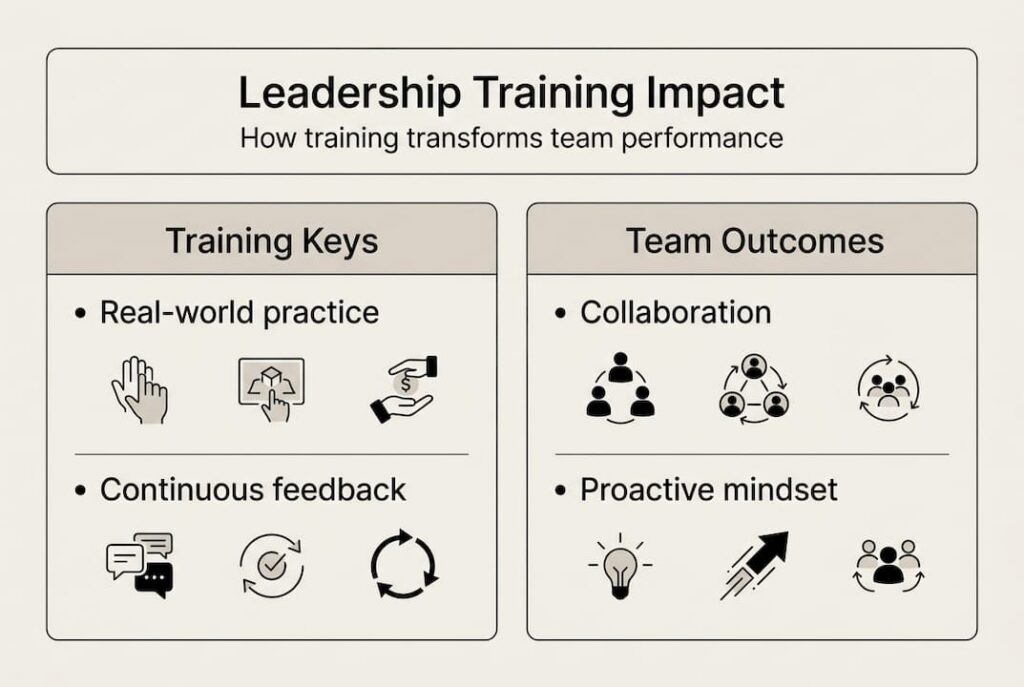
Resilient leadership fundamentally changes how teams handle setbacks. Instead of blame and defensiveness, trained leaders model curiosity and problem-solving. Their teams mirror this approach, viewing obstacles as challenges to overcome rather than reasons to give up.
Consider these tangible improvements organizations see:
- Enhanced problem-solving: Teams generate more creative solutions because leaders ask better questions
- Improved adaptability: Changes that once caused resistance now spark productive discussion
- Stronger morale: People feel heard and valued, increasing commitment to team goals
- Better conflict resolution: Disagreements become opportunities for understanding rather than sources of division
- Increased initiative: Team members take ownership instead of waiting for direction
The shift from reactive to proactive leadership creates cascading benefits. When leaders stop firefighting and start preventing fires, teams operate more smoothly. This efficiency frees capacity for innovation and growth.
Effective training also transforms feedback culture. Leaders learn to deliver constructive input that motivates rather than deflates. They recognize achievements meaningfully and address performance gaps directly. Teams respond with higher engagement and faster skill development.
Crisis management improves dramatically when leaders have practiced decision-making frameworks under pressure. They remain calm, communicate clearly, and mobilize resources effectively. Their composure steadies teams during uncertainty, maintaining productivity when others panic.
Pro Tip: Sustaining gains after training requires deliberate reinforcement. Schedule daily/weekly/monthly leader check-ins where participants share wins, challenges, and insights. This peer learning extends training value and prevents backsliding into old habits.
The connection between leadership quality and team performance becomes obvious when you examine improving team dynamics. Strong leaders create psychological safety, enabling teams to take smart risks and learn from failures. This environment accelerates growth far beyond what traditional management achieves.
Integrating resilience-building exercises into leadership development prepares teams for inevitable challenges. Leaders who’ve practiced navigating adversity guide their teams through difficulties with confidence rather than anxiety.
Choosing the right leadership training for your organization
Selecting effective leadership training requires moving beyond impressive marketing to evaluate actual fit with your needs. The right program addresses your specific challenges and aligns with your culture.
Follow this step-by-step approach:
- Assess current state: Identify specific leadership gaps impacting performance
- Define success: Establish clear outcomes you expect training to achieve
- Research options: Evaluate providers based on customization capability and track record
- Verify methodology: Ensure programs include application, feedback, and measurement
- Check references: Speak with organizations similar to yours who’ve used the program
- Pilot test: Start with a small group before full rollout
- Plan reinforcement: Design post-training support to sustain behavior change
Before committing to any provider, ask these critical questions:
- How will you customize content to our industry and organizational challenges?
- What specific behavioral changes should we expect to see?
- How do you measure program effectiveness beyond satisfaction surveys?
- What post-training support do you provide to reinforce learning?
- Can you share case studies from similar organizations?
- What’s your approach to ensuring leaders apply new skills?
- How do you handle leaders who resist changing their approach?
Your ongoing evaluation checklist should include:
- Daily/Weekly/Monthly progress reviews with participating leaders
- Season/Quarterly assessment of behavioral changes using 360-degree feedback
- Semi-annual measurement of team performance metrics
- Annual program review to refine content and approach
- Continuous pipeline development identifying next cohort of leaders
The best training investments recognize that leadership development never truly ends. Organizations need systems for continuous growth, not one-time events. This means building internal coaching capacity, creating peer learning groups, and establishing clear leadership competency frameworks.
Understanding the role of coaching helps you evaluate whether programs include this critical element. Coaching transforms knowledge into capability through personalized guidance and accountability.
If you’re considering external support, learning what a personal development coach brings to leadership growth clarifies the value of individualized development alongside group training.

Explore leadership training solutions with real impact
You’ve seen the data on what works and what doesn’t. You understand how to measure results and recognize effective program characteristics. Now comes the crucial step: finding training that delivers on these principles.
At Navigating Through Quicksand I offer leadership training designed for success with measurable outcomes at its core. The NTQ approach combines resilience-building with practical leadership frameworks, creating programs tailored to your team’s specific challenges. NTQ doesn’t deliver generic workshops. I partner directly with you to develop leaders who drive real performance improvements. Explore my leadership training services to discover how customized development creates lasting change. My NTQ coaching workshop offerings provide the ongoing support that transforms one-time learning into sustained behavioral shifts. Ready to invest in leadership training that actually works? Let’s build something meaningful together.
Frequently asked questions
Why do so many leadership training programs fail?
Most programs neglect real-world application and measurable goals, focusing instead on theory without practice. A very low percentage of leadership training programs create effective leaders because they lack customization and accountability mechanisms.
How can you measure leadership training success?
Track changes in team performance, engagement scores, and retention rates using before-and-after comparisons. Effective measurement includes both quantitative metrics and qualitative feedback from direct reports.
What features are important in effective leadership training?
Real-world practice opportunities, tailored content addressing specific challenges, actionable feedback mechanisms, and clear alignment with organizational goals matter most. Programs must include post-training reinforcement to sustain behavioral change.
Who should participate in leadership training?
Both current leaders and high-potential employees benefit from ongoing development. Organizations see best results when they create leadership pipelines rather than waiting until promotion to develop capabilities.
How often should organizations revisit their leadership training approach?
Review and adapt your leadership training every one to two years to ensure alignment with evolving business challenges. Continuous refinement based on measured outcomes keeps programs relevant and effective.
Recommended
- Professional Development Leadership Training: Impact on Team Success | Navigating Through Quicksand
- Leading with Heart and Mind: What is the Most Overlooked Dimension of Teamwork? | Navigating Through Quicksand
- Resilience Training Boosts Student Performance | Navigating Through Quicksand
- How to Develop Leadership Skills for Lasting Impact