

Many professionals wonder if professional development truly delivers on its promise of career growth and improved performance. You might have attended workshops that felt disconnected from your daily work, or watched colleagues return from training with little to show for it. This skepticism is understandable given mixed results from generic programs. However, evidence shows that choosing the right professional development creates measurable improvements in retention, well-being, and organizational outcomes. The difference lies in selecting multimodal, job-embedded approaches that combine skill-building with resilience training. This article clarifies how to identify effective professional development that supports sustained personal and organizational growth across education, corporate, and athletic contexts.
Table of Contents
Key Takeaways
| Point | Details |
| Career growth via PD | Choosing programs that blend resilience training with practical skill use leads to meaningful career progress. |
| Resilience boosts well being | Resilience training reduces burnout and helps professionals maintain well being under pressure. |
| Multimodal PD impact | Programs that combine multiple modalities and embed learning in daily work show the strongest impact. |
| Tailored PD matters | Effectiveness improves when PD is tailored to context and guided by clear insights, motivation, practice, and measurement. |
The impact of professional development on careers and organizations
Professional development represents structured learning activities designed to enhance your skills, knowledge, and career prospects throughout your working life. These activities range from formal workshops and certifications to informal mentoring and peer collaboration. When employees feel excited about growth opportunities, and companies offering robust development programs they experience significantly higher retention rates.
Organizations benefit from professional development through improved performance, adaptability, and employee engagement. When you participate in quality programs, you gain current industry knowledge, expand professional networks, and develop competencies that directly apply to your role. This creates a virtuous cycle where individual growth fuels organizational success, which in turn supports further investment in employee development.
Key outcomes from effective professional development include:
- Career progression through expanded skill sets and demonstrated competence
- Enhanced job satisfaction and engagement with meaningful work
- Increased effectiveness in current roles and readiness for advancement
- Stronger professional networks that provide support and opportunities
- Greater organizational adaptability to market changes and challenges
The connection between professional development and retention deserves particular attention. Employees who see clear pathways for growth and receive support in pursuing them demonstrate stronger commitment to their organizations. This pattern holds across sectors, from educators seeking professional development leadership training to corporate teams building collaborative capabilities.
“Professional development is not just about acquiring new skills. It’s about creating a culture of continuous improvement that benefits individuals and organizations alike. When done right, it becomes a strategic advantage that drives retention, performance, and innovation.”
One-size-fits-all trainings often disappoint, while targeted programs aligned with specific professional contexts deliver measurable results. Understanding this distinction helps you make informed choices about where to invest your development time and energy.

How resilience training enhances well-being and performance
Resilience training strengthens your capacity to cope with stress, recover from setbacks, and maintain well-being under demanding conditions. As a core component of effective professional development, resilience training employs evidence-based approaches including mindfulness practices, cognitive behavioral techniques, and structured coaching to build psychological flexibility and adaptive coping strategies.
Research demonstrates that resilience training improves well-being, particularly benefiting educators and clinicians who face high-stress environments. These programs also reduce burnout symptoms and enhance coping abilities across diverse professional contexts. The SMART resilience program for educators and crisis resource management training for clinicians both show sustained improvements in participant well-being and job satisfaction.
For professionals in education, healthcare, and athletics, resilience training addresses the unique pressures of performance-focused roles. Educators managing classroom challenges, clinicians handling patient care demands, and athletes navigating competitive pressure all benefit from structured approaches that build mental toughness and emotional regulation. The impact extends beyond individual well-being to influence team dynamics and organizational culture.
Resilience training delivers specific benefits:
- Reduced burnout symptoms and emotional exhaustion
- Enhanced stress management and recovery capabilities
- Improved decision-making under pressure
- Stronger interpersonal relationships and team cohesion
- Greater career satisfaction and longevity in demanding roles
The connection between resilience and sustained performance becomes particularly evident in athletic contexts. Programs focused on resilience training student athlete performance help young competitors develop mental skills that transfer across competitive and academic settings. Similarly, corporate professionals benefit from mental strength training lasting resilience approaches that build capacity for long-term career success.
Pro Tip: Integrate resilience training into broader professional development initiatives rather than treating it as a standalone intervention. Multimodal programs combining skill-building workshops with ongoing resilience coaching produce stronger, more sustained outcomes than single-session trainings.
The effectiveness of resilience training depends on consistent practice and application. Programs that provide tools for daily use, rather than theoretical concepts alone, enable you to build resilience as an ongoing capability. This practical focus distinguishes high-impact programs from those that generate temporary enthusiasm but limited lasting change.
Choosing effective professional development: methods and measurements
Professional development methodologies vary widely in structure, intensity, and effectiveness. Understanding these differences helps you select programs most likely to produce meaningful results. Common approaches include traditional workshops, job-embedded learning, multimodal programs combining multiple delivery methods, and hybrid formats blending formal instruction with informal coaching.
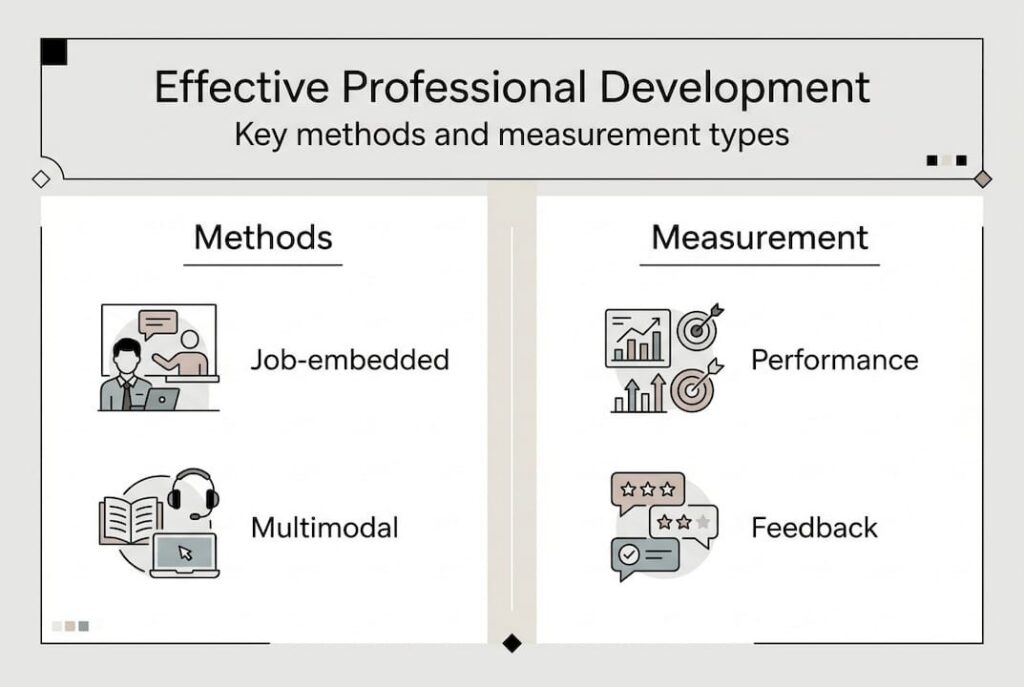
Research shows that job-embedded and multimodal methods yield medium to large effects when properly designed and implemented. These approaches outperform standalone workshops because they integrate learning with authentic work contexts and provide sustained support for application. However, even well-designed programs only impact outcomes when four essential conditions align.
| Method | Typical Effect Size | Best Application Context | Implementation Requirements |
| Traditional workshops | Small to medium | Introducing new concepts or frameworks | Follow-up support and practice opportunities |
| Job-embedded learning | Medium to large | Skill application in authentic settings | Structured reflection and peer collaboration |
| Multimodal programs | Medium to large | Comprehensive skill development | Coordinated delivery across multiple formats |
| Hybrid coaching models | Medium to large | Sustained behavior change | Ongoing support and accountability structures |
Four conditions determine professional development effectiveness:
- Insights: Programs must provide a clear, actionable understanding of what to do differently and why it matters for your specific context.
- Motivation: You need compelling reasons to change current practices, often through seeing concrete benefits or addressing pressing challenges.
- Techniques: Effective training teaches specific, practical methods you can implement immediately in your work.
- Practice: Sustained application with feedback allows you to refine skills and build automaticity over time.
When any of these conditions is missing, professional development struggles to produce lasting change. A workshop might provide excellent insights and techniques but fail to motivate application. Alternatively, you might feel highly motivated to improve but lack practical techniques for doing so. The most effective programs deliberately address all four conditions through coordinated design.
Measurement challenges complicate assessment of professional development effectiveness. Many programs show limited impact on objective outcomes despite positive participant feedback. Self-reports consistently overestimate gains because they reflect satisfaction and intentions rather than actual behavior change. This measurement gap explains why some organizations continue investing in programs that produce minimal real-world results.
Pro Tip: Prioritize professional development programs that measure outcomes through objective performance indicators, peer observation, or work product analysis rather than relying solely on participant satisfaction surveys. Programs confident in their effectiveness welcome rigorous evaluation.
When evaluating potential programs, examine their approach to these four conditions and their measurement methods. Programs offering professional development goals frameworks help you align training with specific career objectives. Resources like the professional development insights available through expert practitioners provide context for making informed choices.
The gap between professional development promise and delivery often stems from inadequate attention to implementation conditions rather than flawed content. High-quality programs recognize that effective learning requires sustained engagement, not just exposure to information.

Applying professional development to your career and organization
Tailoring professional development to your career stage and organizational context maximizes return on investment. Early-career professionals benefit from foundational skill-building and exposure to diverse approaches, while experienced practitioners gain more from advanced techniques and leadership development. Organizations should align professional development offerings with strategic priorities while allowing individual choice in specific pathways.
Hybrid approaches combining formal learning with informal coaching deliver particularly strong results across professional contexts. These multimodal programs integrate structured workshops with ongoing mentorship, peer collaboration, and individualized support. This combination addresses the four essential conditions for effectiveness while adapting to individual learning needs and organizational constraints.
Resilience-building exercises form a crucial component of sustainable professional development. Rather than treating resilience as an innate trait, effective programs teach specific practices for managing energy, recovering from stress, and maintaining performance under pressure. The Corporate Athlete framework emphasizes alternating stress and recovery through deliberate rituals. This approach applies equally to corporate professionals managing demanding workloads and athletes balancing training with competition.
Practical steps for selecting and engaging in effective professional development:
- Assess your current skills and identify specific gaps limiting your effectiveness or advancement
- Research programs offering multimodal delivery with job-embedded practice opportunities
- Verify that programs measure outcomes through objective indicators beyond self-report
- Seek offerings that provide ongoing support and accountability structures
- Connect with peers who have completed programs to understand real-world impact
- Negotiate with your organization for dedicated time and resources to apply new learning
- Establish clear goals and metrics for evaluating your own progress
- Build peer learning communities to sustain motivation and share implementation insights
Professionals exploring your path to excellence benefit from frameworks that integrate skill development with personal growth. Athletes particularly gain from programs addressing self esteem coaching athletes alongside technical skill refinement. Corporate and educational professionals similarly benefit from personal growth coaching that addresses both professional competencies and underlying mindsets.
The most successful professional development participants actively shape their learning experience rather than passively consuming content. You create value by connecting new insights to specific work challenges, experimenting with techniques in authentic contexts, and reflecting on results to refine your approach. This active engagement transforms generic training into personalized capability building.
Organizations supporting professional development should provide protected time for application and experimentation. Learning happens through doing, not just knowing. When you have space to practice new approaches, receive feedback, and iterate on your implementation, professional development delivers on its promise of sustained growth and improved performance.
Explore professional development services to accelerate your growth
Navigating Through Quicksand offers specialized professional development services designed to build resilience and enhance performance across educational, corporate, and athletic contexts. My NTQ programs combine evidence-based resilience training with practical skill development tailored to your specific challenges and goals. Whether you’re an educator seeking to strengthen classroom leadership, a corporate team building collaborative capacity, or an athlete developing mental toughness, my multimodal approach delivers measurable results.
Explore my NTQ professional development workshops, each workshop integrates the four essential conditions for effective learning: actionable insights, compelling motivation, practical techniques, and structured practice opportunities. Participants gain tools they can implement immediately while building long-term capabilities for sustained success.
Real results come from programs that address your whole person, not just isolated skills.

FAQ
What is professional development and why is it important?
Professional development encompasses ongoing learning activities that enhance your skills, knowledge, and career prospects throughout your working life. It includes formal training, workshops, certifications, mentoring, peer collaboration, and self-directed learning. Professional development matters because it keeps your capabilities current with evolving industry demands, expands your professional network, and positions you for career advancement. Organizations benefit through improved employee performance, higher retention rates, and greater adaptability to market changes.
How does resilience training fit into professional development?
Resilience training strengthens your capacity to cope with stress, recover from setbacks, and maintain well-being under demanding conditions. It functions as a key component in multimodal professional development programs by building the psychological flexibility and adaptive coping strategies that sustain performance over time. Resilience training benefits include reduced burnout, enhanced stress management, and improved decision-making under pressure. These capabilities support effective application of other professional skills, making resilience training a foundation for lasting development.
What should I look for when choosing professional development programs?
Prioritize multimodal, job-embedded programs that measure outcomes through objective performance indicators rather than relying solely on participant satisfaction surveys. Effective programs address four essential conditions: actionable insights, compelling motivation, practical techniques, and sustained practice opportunities with feedback. Avoid generic workshops lacking follow-up support or application structures. Seek offerings that provide ongoing coaching, peer collaboration, and accountability systems to support sustained behavior change. Review choosing professional development frameworks to align training with your specific career objectives and organizational context.
How long does it take to see results from professional development?
Initial insights and motivation often emerge during training itself, but meaningful behavior change and performance improvement typically require three to six months of consistent practice and application. Programs providing ongoing support and accountability structures accelerate this timeline by helping you overcome implementation challenges and refine your approach based on real-world feedback. Sustained results depend on integrating new practices into daily routines rather than treating professional development as a one-time event. Expect to invest regular effort over several months before new capabilities become automatic and produce consistent outcomes.
Can professional development really reduce burnout?
Yes, when programs incorporate evidence-based resilience training alongside skill development. Research shows resilience-focused professional development reduces burnout symptoms and improves well-being, particularly for educators and clinicians in high-stress roles. The key lies in learning practical stress management techniques, building recovery rituals, and developing adaptive coping strategies you can apply consistently. Generic training without resilience components may actually increase stress by adding demands without providing tools to manage them. Choose programs explicitly addressing well-being and sustainable performance rather than focusing solely on productivity enhancement.
Recommended
- Professional Development Leadership Training: Impact on Team Success | Navigating Through Quicksand
- 7 Professional Development Goals You Can Set Today: What are Good Professional Development Goals? | Navigating Through Quicksand
- How to Develop Leadership Skills for Lasting Impact
- 6 Benefits of Personal Growth Coaching: The Ultimate Guide | Navigating Through Quicksand
