
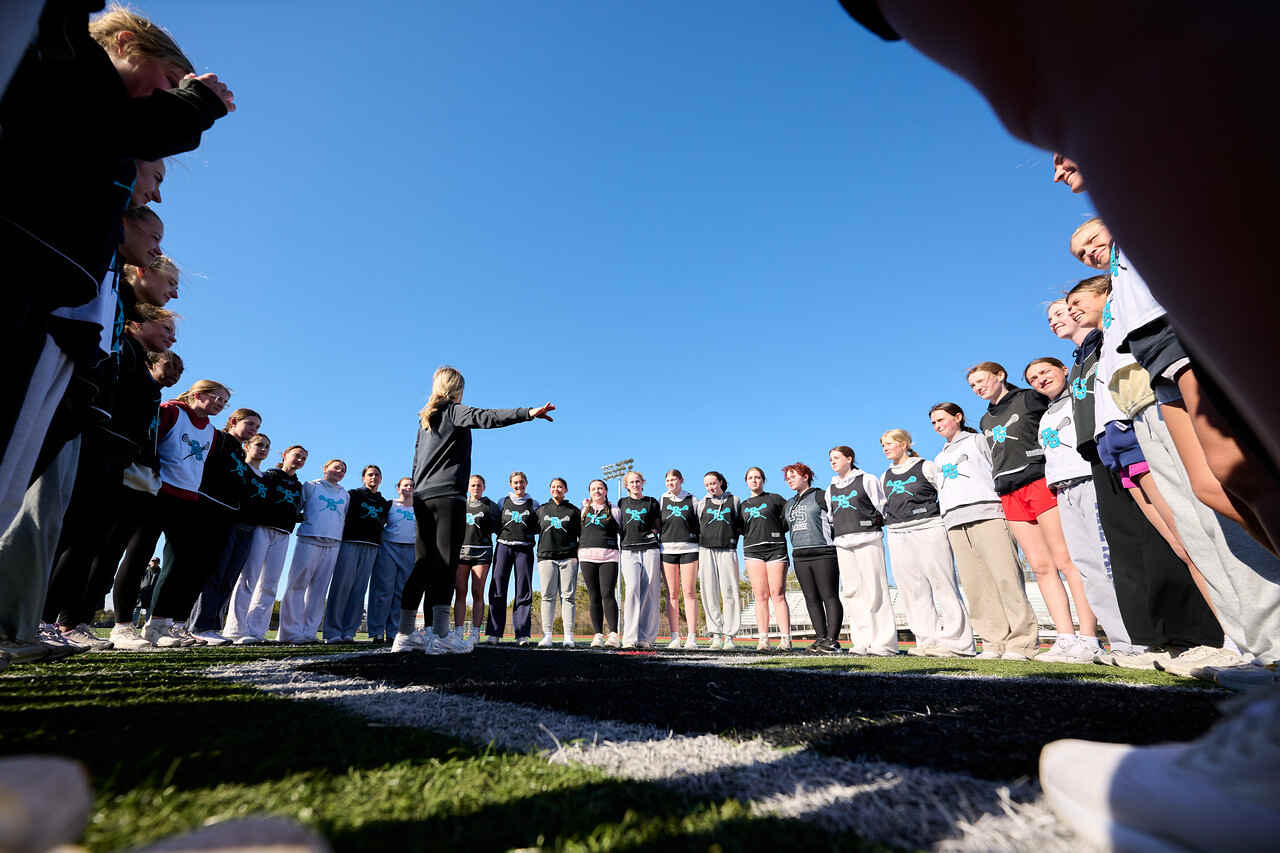
Most people pick one self-improvement strategy, stick with it for a few weeks, and wonder why nothing changes. The problem isn’t effort. It’s the approach. Combined exercise-psychological interventions show the largest effect on well-being compared to any single method, which means stacking the right strategies together is what actually moves the needle. Whether you’re a student athlete, a coach, or a corporate leader, this guide breaks down the evidence-backed frameworks that build real resilience, prevent burnout, and create lasting personal growth across every environment you operate in.
Table of Contents
Key Takeaways
| Point | Details |
| Combined strategies work best | Integrating psychological and exercise-based interventions leads to the greatest improvements in well-being. |
| Resilience drives performance | Building resilience directly correlates with higher achievement across athletics, education, and workplaces. |
| Mindset matters | An iterative and growth mindset is essential for sustaining progress and benefiting most from self-improvement efforts. |
| Prevent burnout actively | Problem-focused coping and strong psychosocial support play pivotal roles in maintaining sustainability. |
| Apply strategies for lasting results | Practical approaches used together—rather than in isolation—result in long-term personal and professional growth. |
Understanding foundational self-improvement frameworks
Before you can build resilience or sustain growth, you need to understand why certain strategies work and others stall. Two mindsets sit at the core of effective self-improvement: the growth mindset and the iterative mindset.
A growth mindset is the belief that your abilities can expand through effort and learning. It’s not just positive thinking. It’s a fundamental shift in how you interpret setbacks, feedback, and challenge. Growth mindset interventions improve academic grades in lower-achieving students, which shows this isn’t just motivational theory. It produces measurable results.
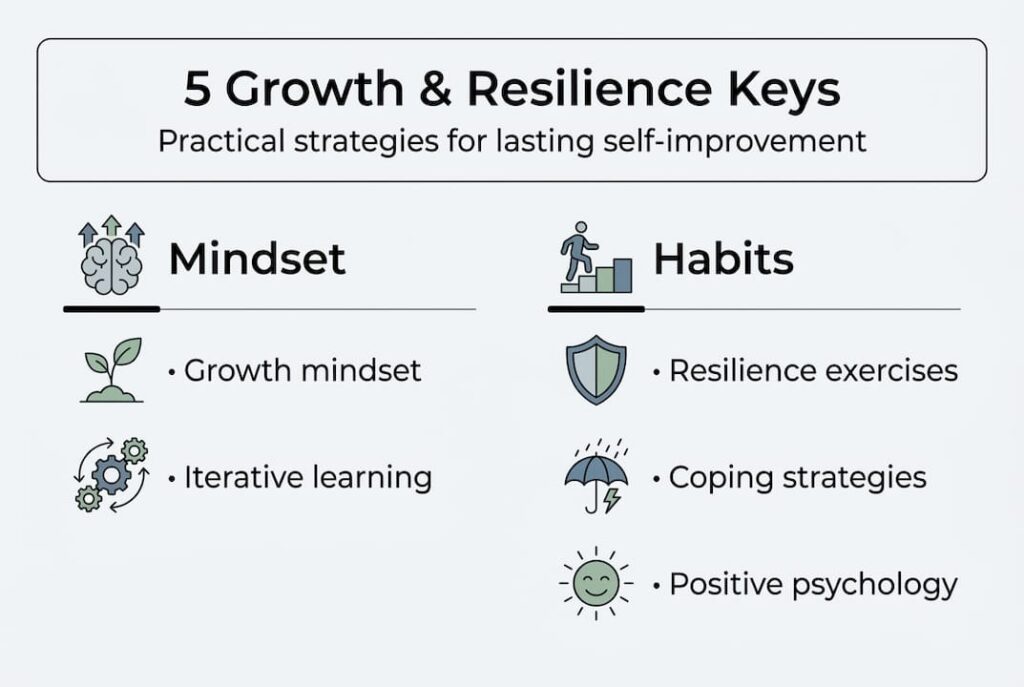
An iterative mindset takes things a step further. Instead of just believing in growth, you actively practice, evaluate, and adjust your actions. Think of it like a feedback loop. You try something, measure the result, and refine your approach. Research shows that an iterative mindset and well-being are linked through self-efficacy, meaning the more you practice this cycle, the more confident and capable you feel over time.
Understanding what is self improvement in a structured way helps you move beyond vague goals and into a system that actually works.
Here are the core frameworks that support lasting improvement:
- Growth mindset: Reframe failure as information, not identity
- Iterative mindset: Build practice-assess-adjust cycles into daily routines
- Positive psychology: Focus on strengths and what’s working, not just deficits
- Mindfulness: Build awareness of thoughts and reactions before responding
- Physical exercise: Supports mood regulation and cognitive performance
Not every framework fits every environment equally. Here’s a quick comparison:
| Framework | Best fit environment | Primary benefit |
| Growth mindset | Education | Academic performance and persistence |
| Iterative mindset | Athletics and corporate | Skill refinement and goal achievement |
| Mindfulness | All environments | Stress reduction and focus |
| Positive psychology | Corporate and coaching | Motivation and engagement |
| Physical exercise | Athletics and wellness | Physical and mental well-being |
Pro Tip: Don’t try to implement every framework at once. Pick one mindset shift and one physical or psychological habit, then layer in more over 4 to 6 weeks as each becomes automatic.
Building resilience: Techniques and their impact
Resilience isn’t a personality trait you either have or don’t. It’s a skill set you build deliberately over time.
What’s most useful is understanding which techniques actually build resilience so you can apply them directly.
| Technique | Environment | Measured impact |
| Problem-focused coping | Athletics, corporate | Reduces burnout, improves performance |
| Mindfulness practice | All environments | Lowers anxiety, increases focus |
| Team cohesion building | Athletics, education | Strengthens social support networks |
| Empathy development | Corporate, education | Reduces conflict, improves adaptability |
Here are four resilience-building techniques:
- Problem-focused coping: Address the stressor directly rather than avoiding it. This means identifying what you can control and taking action there first.
- Mindfulness-based stress reduction: Regular mindfulness practice rewires how your brain responds to pressure. Even 10 minutes a day creates measurable changes over weeks.
- Team cohesion strategies: In athletics and corporate teams, shared goals and mutual accountability create a resilience buffer. When one person struggles, the group lifts them.
- Empathy training: Leaders and coaches who practice empathy create environments where people feel safe to fail, learn, and grow without fear of judgment.
For students and athletes, boosting student resilience through structured programs delivers results that go beyond the classroom or the field. They carry over into every area of life. Understanding adversity examples in athletics can also help normalize the struggle and reframe it as part of the process.
If you want a practical starting point, resilience exercises give you structured tools you can use immediately. And if you’re curious how physical training intersects with mental toughness, climbing training trends offer an interesting window into how elite athletes are combining physical and psychological conditioning right now.
Applying psychological interventions: What works and why
Mindfulness alone helps. Yoga alone helps. Positive psychology alone helps. But none of them hit as hard as when you combine them with physical exercise.
Here’s what works when you layer these interventions:
- Mindfulness plus exercise: Reduces cortisol, improves mood, and sharpens focus simultaneously
- Compassion practices plus team sport: Builds psychological safety and reduces interpersonal conflict
- Positive psychology plus structured goal-setting: Increases motivation and follow-through on long-term objectives
- Yoga plus a moment of gratitude: Combines body-based regulation with cognitive processing for stress relief
The key is intentional stacking. You’re not just doing more things. You’re choosing combinations that reinforce each other. A moment of gratitude followed by a morning run isn’t random. It’s a system.
For athletes and students, self-esteem coaching plays a critical role in making these interventions stick. Without a solid foundation of self-worth, people abandon new habits the moment they hit a rough patch. Pairing that with mental strength training creates a framework where both the mindset and the habits reinforce each other.
Pro Tip: Track your interventions like an athlete tracks performance. Log what you did, how you felt before and after, and what changed over a week. Patterns will emerge that tell you exactly what combination works best for you.
Preventing burnout and sustaining progress
Here’s where most self-improvement plans fall apart. You build momentum, stack good habits, feel the progress. Then life gets hard, and everything collapses. Burnout isn’t a character flaw. It’s what happens when demand consistently outpaces recovery.
Research on athletes shows that coping strategies and burnout are directly linked through the type of coping you use. Problem-focused coping reduces burnout. Avoidance coping increases it. And psychosocial resources, like strong social support and a sense of belonging, moderate the whole relationship.
This applies just as much in a corporate office or a classroom as it does on a sports field.
Here’s how to prevent burnout while keeping your improvement momentum:
- Audit your recovery habits: Sleep, nutrition, and downtime aren’t optional. They’re the foundation everything else rests on.
- Build social support intentionally: Isolation accelerates burnout. Regular check-ins with mentors, teammates, or peers create the psychosocial buffer that research supports.
- Replace avoidance with action: When stress spikes, the instinct is to avoid the problem. Flip that. Identify one small action you can take toward the stressor today.
- Set process goals, not just outcome goals: Focusing only on results creates pressure without direction. Process goals give you something to succeed at every single day.
- Schedule deload periods: Just like athletes use deload weeks to recover physically, build planned recovery periods into your personal and professional growth plan.
For anyone wondering whether the investment is worth it, investing in resilience breaks down the long-term returns clearly. And for students managing multiple demands, student athlete balance tips offer a realistic framework for staying on track without burning out.
If you want to build the physical foundation that supports mental resilience, a build strength step by step approach gives you a structured way to develop both simultaneously.
The missing link in self-improvement most people ignore
Most self-improvement content gives you a list of tactics. Meditate. Exercise. Journal. Set goals. The advice isn’t wrong. But it misses the deeper mechanism that makes any of it work long-term.
The real missing link is the synergy between resilience and iterative learning. Resilience keeps you in the game when things go wrong. An iterative mindset ensures you’re learning from every round. Together, they create a self-correcting system that gets stronger under pressure instead of breaking down.
When you treat setbacks as data points rather than verdicts, everything changes. That iterative mindset and well-being connection through self-efficacy isn’t just academic. It’s the difference between someone who quits after one hard month and someone who adjusts and keeps moving.
Most people focus on isolated tactics because tactics feel actionable. But systems thinking, where you ask “how does this habit connect to that one?” and “what feedback loop am I building?” is what separates sustainable growth from short-term motivation. Pair that with the mental strength training perspective, and you have a framework that actually holds up under real-world pressure.
Take your self-improvement journey further
Reading about these strategies is a strong start. Putting them into practice with expert guidance is where the real shift happens.
At NavigatingThroughQuicksand.com, I offer interactive workshops/assemblies, one on one confidence coaching, and professional development programs built specifically for students, athletes, and corporate teams who want more than motivation. They want results. Whether you’re looking for student resilience training, structured resilience building exercises you can implement immediately, or leadership training solutions for your organization, there’s a path forward designed for where you are right now. Take the next step today.
Frequently asked questions
Which self-improvement strategies have the strongest research backing?
Combined exercise-psychological interventions show the largest effect on well-being, with mindfulness, yoga, and positive psychology also delivering moderate benefits when used individually.
What’s the best way to prevent burnout while improving?
Problem-focused coping reduces burnout while avoidance strategies increase it. Coping strategies and burnout research confirms that psychosocial resources like social support are key moderators in keeping burnout at bay.
Can self-improvement techniques boost student and workplace achievement?
Yes. Growth mindset interventions improve academic grades, especially for lower-achieving students, and resilience training produces similar gains in adaptability and performance within corporate teams.
Are group-based or individual-centered approaches better for self-improvement?
Group-based approaches build team cohesion and shared resilience, while individual-centered methods develop personal empathy and self-awareness. Coach orientations and resilience research suggests the most effective programs blend both orientations based on the individual’s and team’s current needs.